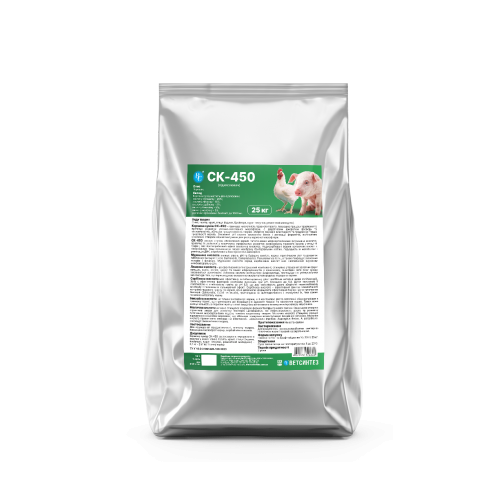
| Ingredients: | formic acid, citric acid, sorbic acid, benzoic acid, lactic acid, bentonite |
| Application: | Orally with food |
| Type of formulation: | feed additive |
Description
Powder.
Composition
The feed mixture contains the following active ingredients:
formic acid - 20%;
citric acid - 10%;
sorbic acid - 5%;
benzoic acid - 5%;
lactic acid - 5%.
Excipients: bentonite up to 1000 mg.
Pharmacological properties
Feed mixture SK-450 - increases the acidity of the digestive tract, improves digestion and suppresses the development of opportunistic microflora, is an additional source of phosphorus and trace elements, increases animal productivity. It preserves nutritional properties and extends the shelf life of feed. Lowering the pH promotes the absorption of proteins and activation of enzymes, improves digestion. Creates favourable conditions for the growth of beneficial microflora.
SC-450 reduces the degree of contamination of feed with pathogenic microorganisms (formic acid), inhibits their development in the intestine, prevents the development of diseases of the digestive tract in poultry and animals, and has an antifungal effect (lactic acid). Undissociated forms of organic acids are lipophilic, therefore, penetrating the membrane of bacterial cells, they disrupt their metabolism and DNA replication, causing a bacteriostatic effect.
Formic acid lowers the pH level and buffering capacity of the feed, inhibiting the growth and development of pathogenic bacteria: E. coli, Salmonella, Campilobacter, Pseudomonas, etc., and improves the absorption of calcium and phosphorus. Formic acid has the strongest antibacterial effect among carboxylic acids.
Citric acid is an effective anti-stress component, stimulating the formation of chelated forms of calcium, potassium, iron, zinc and other trace elements in the intestine, which makes them better absorbed by the body. Citric acid neutralises radionuclides, pesticides and is a universal antioxidant that prevents the oxidation of fats and prevents feed spoilage.
Pharmacological properties
Feed mixture SK-450 - increases the acidity of the digestive tract, improves digestion and suppresses the development of opportunistic microflora, is an additional source of phosphorus and trace elements, increases animal productivity. It preserves nutritional properties and extends the shelf life of feed. Lowering the pH promotes the absorption of proteins and activation of enzymes, improves digestion. Creates favourable conditions for the growth of beneficial microflora.
SC-450 reduces the degree of contamination of feed with pathogenic microorganisms (formic acid), inhibits their development in the intestine, prevents the development of diseases of the digestive tract in poultry and animals, and has an antifungal effect (lactic acid). Undissociated forms of organic acids are lipophilic, therefore, penetrating the membrane of bacterial cells, they disrupt their metabolism and DNA replication, causing a bacteriostatic effect.
Formic acid lowers the pH level and buffering capacity of the feed, inhibiting the growth and development of pathogenic bacteria: E. coli, Salmonella, Campilobacter, Pseudomonas, etc., and improves the absorption of calcium and phosphorus. Formic acid has the strongest antibacterial effect among carboxylic acids.
Citric acid is an effective anti-stress component, stimulating the formation of chelated forms of calcium, potassium, iron, zinc and other trace elements in the intestine, which makes them better absorbed by the body. Citric acid neutralises radionuclides, pesticides and is a universal antioxidant that prevents the oxidation of fats and prevents feed spoilage.
Sorbic acid has an effective antibacterial effect and is most active against colibacilli. It is an effective factor in controlling pathogens at pH close to 5.0. A very important feature is its stability even at pH 6.8, which makes it possible to preserve the undissociated molecule for a long time and enhance the inhibitory effect. Sorbic acid is an effective factor in the mycological control of the digestive tract and feed, it helps to form an effective barrier against pathogenic bacteria (Salmonella, E.Coli, etc.), inhibiting their vital activity and destroying them, thereby enhancing feed safety.
Benzoic acid not only disinfects feed, but also controls pH and pathogens in the digestive tract, resulting in improved animal health and feed digestibility. It also reduces the number of enterobacteria in the cecum without adversely affecting the intestinal microflora.
Lactic acid actively stimulates the secretion of pancreatic enzymes. At the same time, it creates favourable conditions for the development of Lactobacillus bacteria, which prevent the growth and development of pathogenic microorganisms in the small intestine of animals. Lactic acid stimulates the process of intestinal villi regeneration, which increases the absorption surface of nutrients. Lactic acid has a preventive effect on mycotoxin-aflatoxin (fungus: Aspergilus flavus, A parasiticus), improves the taste of feed.
Benzoic acid not only disinfects feed, but also controls pH and pathogens in the digestive tract, resulting in improved animal health and feed digestibility. It also reduces the number of enterobacteria in the cecum without adversely affecting the intestinal microflora.
Lactic acid actively stimulates the secretion of pancreatic enzymes. At the same time, it creates favourable conditions for the development of Lactobacillus bacteria, which prevent the growth and development of pathogenic microorganisms in the small intestine of animals. Lactic acid stimulates the process of intestinal villi regeneration, which increases the absorption surface of nutrients. Lactic acid has a preventive effect on mycotoxin-aflatoxin (fungus: Aspergilus flavus, A parasiticus), improves the taste of feed.
Application
Improved animal productivity, improve feed conversion, and sorption of mycotoxins.
Dosage
Feed mixture SK-450 is administered orally in doses:
- pigs, calves, rabbits, poultry (turkeys, broilers, laying hens, and young stock): 0.5 kg - 2 kg per 1 tonne of feed.
Contraindications
Not established.
Warnings
Adhere to generally accepted sanitary and hygienic standards and rules at work.
Form of release
1 kg bags and kraft bags of 10, 20 and 25 kg.
Storage
Store in a dry, dark place at temperatures between 5 and 25°C.
Shelf life
2 years
Name and location of the manufacturer(s)
Vetsintez Limited Liability Company
30 Taras Bobanych St., Kharkiv, 61001, Ukraine