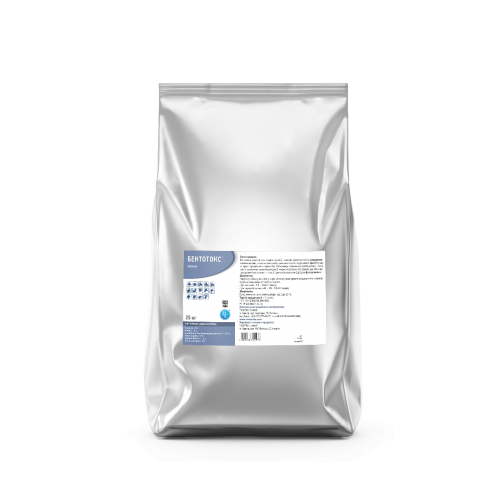
| Ingredients: | Bentonite, kaolin, yeast powder, kelp, calcium propionate, citric acid |
| Application: | Oral |
| Type of formulation: | Adsorbent (feed additive) |
Composition
100 g contains:
- bentonite - 50
g;
- kaolin - 5 g;
- yeast powder
(Saccharommyces cerevisiae) - 32.5 g;
- kelp - 5 g;
- calcium
propionate - 5 g;
- citric acid - 2.5 g
Pharmaceutical form
Powder
Pharmacological properties
The feed
additive has evident sorption properties thanks to bentonite and kaolin.
Bentonite effect is directed to the absorption of mycotoxins, free radicals and toxic technogenic substances (pesticides, dioxins, ammonia etc.) The bentonite composition includes calcium, sodium, sulfur, ferrum, cuprum, manganese.
Bentonite
as an active absorber absorbs excessive gases that are formed in a rumen during
digestion of lush grass and thus it prevents tympania (meteorism) in animals.
One of the most important properties of bentonite is a high buffering property
and ability to optimize pH cicatrical content within neutral and subacid
reaction what improves development of cellulosolytic microflora and cellulose
digestion, increases formation of acetic acid in a rumen that was used for fat
formation in milk. In addition, having in its composition micro elements increases intensity of rumen microflora formation and
makes better digestion of all nutrients of food allowance.
Bentonite increases egg laying
capacity, at decrease of fodder use quality of shell will be better, egg mass
will increase and moisture of excrements will decrease, plumage of poultry will
be better.
In its turn, kaolin prevents caking
and lump formation of fodder as well as any food poisonings, it binds with
molecular structure of mycotoxins by irreversible method what ensures
impossibility of any chemical reaction of toxins renewal and their re-effect on
animal's organism.
Kelp compensates the inhibitory
action of mycotoxins on immunity and has a source of mineral substances (macro
and micro elements), including: potassium,
magnesium, phosphorus, ferrum, zinc, cuprum, manganese. It contains a high level
of iodine, improves digestive organs function, assists in excretion of
intestinal parasites, increases immunity, stimulates metabolism process, has
impact on endocrine glands. Iodine
that was received by an organism by means of cuprum and manganese accumulates
by thyroidal follicles of a thyroid gland in protein thyroglobulin, a full
hormone thyroxin or tetraiode-thyronine required for increase of the animals’
productivity as it increases intensity of cardiac function and blood transportation
to different parties of the body is synthesized from it.
Yeasts have sorbing activity in
respect of aflatoxins, fumonisins and zearalenones. Because of mannans and
β-glucans content the component allows to stimulate immunity and increase
adsorption of mycotoxins such as DON and zearalenone.
Inclusion in the category of organic
acids or their salts maintains the antibacterial effect and an optimal pH level
for effective sorption of mycotoxins in intestines and for inhibition of
pathogenic microbiotas optimizing its composition and increasing the fodder
conversion. Calcium propionate activates minerals as well as prevents any mold
formation in the finished fodder and does not allow them to discharge toxins.
In combination with citric acid calcium propionate stops toxins in the absorbed
form and prevents its release in the sequential parts of the digestive tract.
Citric acid is an effective anti-stress component that stimulates formation of chelate forms of calcium, potassium, ferrum, zinc and any other micro elements in intestines as a result of what they are better ingested by an organism. Citric acid neutralizes radionuclides, pesticides and it is an universal antioxidant that prevents oxidation of fats and spoilage of fodders.
Clinical particular features
Animal species
Cattle, sheep, goats, pigs and poultry
Indications
It shall be added to fodders for poultry and animals for the purposes of prevention of their contamination by mycotoxins as well as their re-affection during storage, transportation and processing. Ensures an optimal quality of fodders, improves its assimilation because of alimentary canal microflora regulation what increases productivity of animals and poultry. Renews the barrier function of liver.
Contraindications
N/A.
Side effects
N/A.
Special precautions during use
N/A.
Use during pregnancy, lactation and carrying
According to the recommended dosage.
Drug-to-drug interactions and other forms of interactions
N/A.
Dosage and administration route for animals of different age
The feed
additive shall be added to the fodder by uniform mixing on the basis of the
contamination level by mycotoxins:
- in case of a
low one - 0.5 - 1.0 kg per ton of fodder;
- in case of a medium or a high one - 1.0 - 2.0 kg per ton of fodder
Special warnings for individuals and staff
According to the existing regulations.
Shelf life
2 years from the date of production.
Special measures for storage
Keep in a dry, dark place out of reach of children at the temperature of 5 - 25 °С.
Nature and content of the original package container
Special measures for handling unused additive or its residues
Dispose of in
accordance with the applicable legislation.