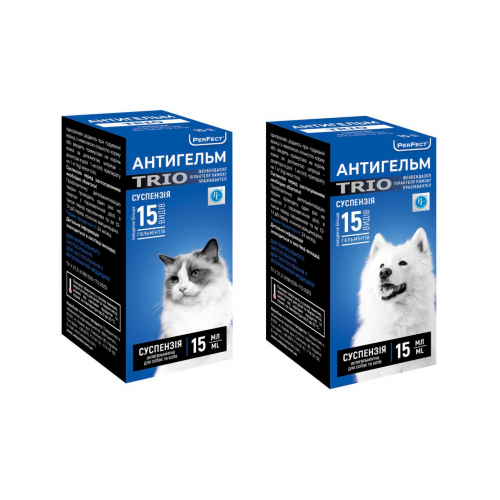
ANTIHELM TRIO suspension (for dogs and cats, 15 ml)
| Ingredients: | fenbendazole, pyrantel pamoate, praziquantel |
| Application: | Orally |
| Type of formulation: | Anthelmintic |
Description
A light yellow to yellow suspension with visible light and dark particles and a characteristic odour of the ingredients, which may separate on storage.
Composition
1 ml of the product contains active substances (mg):
- fenbendazole - 20,0;
- pyrantel pamoate - 15,0;
- praziquantel - 5,0.
Excipients: flavour, xanthan gum, bentonite, sucralose, sodium benzoate, propylene glycol, purified water.
Pharmacological properties
ATCvet code: QP52 – anthelmintics, veterinary. QP52AA51 – praziquantel, combinations. QP52AF02 – pyrantel.
ANTIHELM TRIO suspension is a combination product containing fenbendazole, pyrantel pamoate and praziquantel. The broad spectrum of anthelmintic action against various developmental stages of roundworms and tapeworms in dogs and cats is based on the pharmacological properties of the product's constituents.
Fenbendazole (benzimidazole group) inhibits the polymerisation of tubulin proteins into microtubules, thereby disrupting the uptake and intracellular transport of nutrients (adenosine triphosphate and glucose), which causes death of the parasites from depletion.
Fenbendazole has a broad-spectrum anthelmintic activity against nematodes, cestodes and trematodes of the gastrointestinal tract and respiratory system, and also exhibits ovocidal action (destroys helminth eggs), reduces contamination of pastures and dog walking areas with helminth eggs, and decreases the probability of re-infection of animals.
Fenbendazole is not cumulative and does not have embryotoxic, mutagenic or allergenic effects and is considered to be of low toxicity.
Following oral administration, fenbendazole is absorbed in the gastrointestinal tract and penetrates into organs and tissues. It is excreted from the body mainly in urine and faeces in unchanged form or as metabolites.
Pyrantel pamoate (tetrahydropyrimidine group) is active against immature and adult nematodes, affecting their cholinergic receptors, which leads to irreversible spastic paralysis of the parasites. Pyrantel pamoate is poorly absorbed from the intestine and due to this its anthelmintic action is prolonged. It is excreted from the body mainly in unchanged form (up to 93%) in faeces.
The combination of the active substances fenbendazole and pyrantel contained in the product have a synergistic action against nematodes in dogs and cats: Toxocara canis, Toxocara cati, Toxascaris leonina, Ancylostoma spp., Uncinaria spp., Trichuris vulpis, as well as against Giardia duodenalis (syn. G. lamblia).
Praziquantel is a derivative of pyrazinoisoquinolines. It is active at preimaginal and imaginal developmental stages of cestodes in dogs and cats: Taenia species, Dipylidium caninum, Echinococcus granulosus, Echinococcus multilocularis, Mesocestoides spp., Diphyllobothrium latum. Praziquantel is very rapidly absorbed by the surface of the parasite and spreads throughout its body. In vitro and in vivo studies demonstrate that praziquantel destroys the outer covering (tegument) of the parasite. This results in an almost instantaneous tetanic contraction of the parasite's musculature and rapid vacuolisation of the outer covering.
This rapid contraction is explained by changes in the permeability of the parasite's cell membranes to divalent cations, especially calcium. Depolarisation of neuromuscular junctions, impairment of glucose uptake and disruption of microtubular function in cestodes lead to impaired muscle innervation, paralysis and death of the parasite.
Following oral administration, praziquantel is rapidly and almost completely absorbed from the gastrointestinal tract and reaches maximum concentration in blood plasma within 1-3 hours. Its oral bioavailability is approximately 80%. Praziquantel is metabolised into inactive forms in the liver and excreted in bile. It is eliminated from the body in urine and in small amounts in faeces within 48 hours.
The product at recommended doses does not have sensitising, embryotoxic or teratogenic effects.
Indications for use
For the treatment and prevention (prophylaxis) of nematode, cestode and trematode infections in dogs and cats caused by:
- nematodes - Toxocara canis, Toxocara cati (syn. Toxocara mystax), Toxascaris leonina, Ancylostoma spp., Uncinaria spp., Trichuris vulpis, Strongyloides stercoralis;
- cestodes - Dipylidium caninum, Taenia spp., Echinococcus spp., Mesocestoides spp., Diphyllobothrium latum;
- trematodes - Opisthorchis felineus, Alaria alata.
Dosage and method of administration
The product is administered to animals individually, as a single dose mixed with a small amount of feed during morning feeding or administered forcibly onto the root of the tongue using a dosing syringe at a dose of 1 ml of the product per 1 kg body weight.
Shake the suspension well before use!
Fasting and use of laxatives are not required.
Treatment is carried out once. If necessary, repeat after 10–14 days as indicated.
Prophylactic anthelmintic treatment of animals is carried out every 3 months at the therapeutic dose, and also before mating and 12-14 days before each vaccination.
Contraindications
Hypersensitivity to the active substances or to any of the excipients.
Do not use in puppies and kittens under 3 weeks of age.
Do not use in females during the first half of pregnancy and within two weeks after parturition.
Do not use in animals suffering from infectious diseases or in exhausted or debilitated animals.
Do not use in animals with impaired kidney or liver function.
Do not use concurrently with piperazine and preparations that inhibit cholinesterase.
Special warnings
Use the product in accordance with this package leaflet.
In heavily infected animals, diarrhoea, vomiting, urticaria, pruritus in the perianal region and restlessness may occur transiently. These signs usually resolve without treatment. Anthelmintic treatment of females 3 weeks before expected parturition and 2-3 weeks after parturition should only be carried out following risk assessment under the supervision of a veterinary surgeon.
Pharmaceutical form and pack sizes
Bottles made of neutral glass grade NS-1, NS-2, USP-1 or polymer bottles of 5, 10, 15, 20, 30 or 50 ml, packed in cardboard boxes. An oral dosing syringe is included in the carton.
Storage conditions
Keep out of the sight and reach of children. Store in a dry, dark place at 5–25°C. Keep away from food, drink and animal feeding stuffs.
Shelf life
24 months.
Use within 30 days after first opening, when stored in a dark place at a temperature from 5 to 10°C.
For veterinary use only!