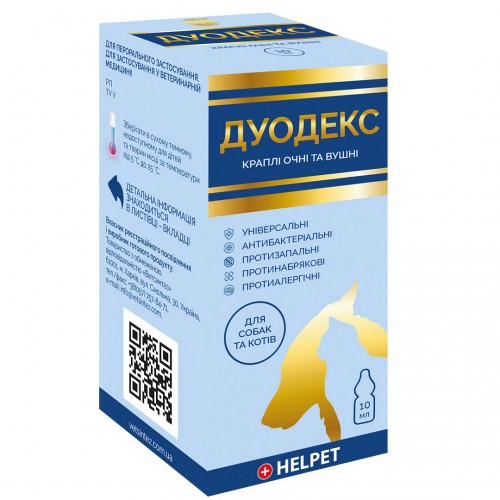
DUODEX (ear and eye drops)
| Ingredients: | dexamethasone, ofloxacin |
| Application: | ear and eye drops |
| Type of formulation: | antibiotic |
Description
Transparent solution, from colourless to light yellow.
Composition
1 ml of the product contains active substances (mg):
- dexamethasone sodium phosphate – 1,32 (equivalent to dexamethasone – 1,0 mg);
- ofloxacin – 3,0.
Excipients: sodium thiosulfate, disodium edetate (EDTA), sodium chloride, benzalkonium chloride, hydroxypropylmethylcellulose, hydrochloric acid, sodium hydroxide, water for injection.
Pharmacological properties
ATCvet code QS03 – ophthalmological and otological veterinary medicinal products; QS03CA01 – dexamethasone and antiinfectives.
DUODEX ear and eye drops is a combination veterinary medicinal product containing a broad-spectrum fluoroquinolone antibiotic (ofloxacin) and a glucocorticosteroid (dexamethasone) and has antibacterial, anti-inflammatory, antiallergic and desensitizing properties.
Dexamethasone is a synthetic glucocorticosteroid with strong anti-inflammatory, anti-edematous, antiallergic and other hormonal and metabolic effects.
The anti-inflammatory effect of dexamethasone is 30 times stronger than that of natural cortisol and 7–10 times stronger than that of prednisolone. Dexamethasone prevents the development of the inflammatory process: redness, swelling, pain. It inhibits capillary dilatation and phagocytosis, stabilizes lysosomal enzymes of leukocyte membranes, suppresses the synthesis of kinins, mitosis and leukocyte migration, inhibits antibody synthesis and prevents allergic reactions that develop after exposure to an antigen.
Ofloxacin is an antibiotic of the fluoroquinolone group, active against Gram-negative microorganisms, namely: Escherichia coli, Salmonella spp., Proteus spp., Shigella spp., Klebsiella spp., Enterobacter spp., Campylobacter spp., Yersinia spp., Pseudomonas aeruginosa, Vibrio spp., Aeromonas spp., Haemophilus spp., Serratia spp., Chlamydia spp. It is active against some Gram-positive microorganisms, in particular Staphylococcus spp. (including penicillinase-producing and methicillin-resistant strains), Streptococcus spp. Enterococcus faecalis, Pseudomonas spp., Streptococcus pneumoniae are moderately sensitive to ofloxacin. Brucella spp., Mycoplasma spp., Mycobacterium spp. are also sensitive to the medicinal product.
The mechanism of action of ofloxacin is inhibition of bacterial DNA gyrase (topoisomerase II), which stops the process of supercoiling and DNA synthesis.
The anti-inflammatory effect of dexamethasone after instillation lasts 4–8 hours. With local application, systemic absorption is low. After instillation into the eyes, dexamethasone penetrates well into the corneal epithelium, conjunctival cells and the aqueous humour of the anterior chamber of the eye; its maximum concentration of 30 mg/ml is recorded after 2 hours, and the half-life is 3 hours. After instillation into the ear, the maximum concentration in blood is observed after 15–90 minutes.
A significant advantage of ofloxacin compared to other topical antibiotics is its high permeability into the cornea and anterior chamber of the eye. Among all fluoroquinolones, ofloxacin has the best ability to penetrate the cornea and anterior chamber of the eye; its effective concentration in the tear film persists even 4 hours (240 minutes) after administration and its MIC90 is above 2 μg/ml. Systemic reabsorption after local administration into the conjunctival sac is insignificant and has no clinical significance.
Instillation of ofloxacin into the ear in the case of an intact tympanic membrane is accompanied by minimal absorption in the middle ear. However, absorption of ofloxacin increases in perforations of the tympanic membrane. After instillation of ofloxacin to adult animals with tympanic membrane perforation, the maximum concentration in blood serum is 10 mg/ml.
With local use of ofloxacin, therapeutic concentration in ocular tissues is reached within 30–60 minutes.
After a single administration of the medicinal product, the concentration of ofloxacin in blood serum after 10 days was 1000 times lower than the concentration after oral administration.
Indications
Treatment of dogs and cats with acute and chronic eye and ear diseases caused by microorganisms sensitive to ofloxacin.
Dosage and administration
For treatment of the eyes, instill the product into the conjunctival sac 1–2 drops 2–4 times daily. In severe cases, during the first 1–2 days, instill 1–2 drops into the conjunctival sac every 2–3 hours, then continue with the usual dosage.
For treatment of ear diseases, instill the product into the external auditory canal 1–4 drops (depending on the animal breed and anatomical structure of the auricle) 2–4 times daily until complete disappearance of signs of inflammation.
In the presence of significant purulent or mucopurulent discharge, perform preliminary hygienic treatment of the eyes or ears, then instill the product.
The course of treatment until complete recovery is 5–10 days.
Avoid contact of the dropper tip with any surface to prevent contamination of the contents of the bottle.
Contraindications
Hypersensitivity to the components of the medicinal product (including in history), glaucoma and corneal ulcers.
Do not administer concurrently with tetracyclines, macrolides, lincosamides, cyclosporins, chloramphenicol.
Do not use in viral and fungal lesions of the eyes and ears.
Do not use during vaccination.
Do not use in horses.
Do not administer concurrently with theophylline and nonsteroidal anti-inflammatory medicinal products, as well as with medicinal products containing magnesium, aluminum and calcium cations, which, by binding with ofloxacin, interfere with its absorption.
Do not use when resistant strains of pathogens are detected.
Warnings
Adverse reactions
When instilled into the eyes, local signs of discomfort, irritation, itching, lacrimation may occur, which resolve quickly; allergic reactions are rare. With prolonged use, secondary glaucoma, steroid cataract, and corneal thinning may develop.
Special precautions for use
In accordance with clinical practice, treatment should be based on determination of the sensitivity of the isolated causative microorganism to ofloxacin. Use with caution in animals under 7 days of age and in pregnant animals.
Use during pregnancy, lactation, lay
If necessary, use with caution. Use of the medicinal product during pregnancy or lactation should be based on a benefit/risk assessment by the responsible veterinarian in each individual case.
Form of release
Polymer or glass bottles with a dropper cap of 10 and 15 ml, packed in cardboard boxes.
Storage
Store the medicinal product in a dry, dark place, out of reach of children and animals, separately from food and feed, at a temperature from 10 to 25 °C.
Shelf life
3 years from the date of manufacture.
The shelf life after first opening of the vial is 30 days provided aseptic withdrawal of the product and subsequent storage of the container with the product at a temperature from 10 to 25 °C.
For veterinary use only!