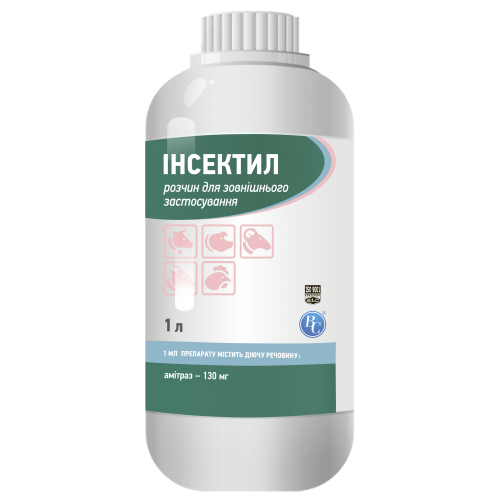
| Ingredients: | amitraz |
| Application: | outwardly |
| Type of formulation: | insect and acaricidal |
DESCRIPTION
An oily liquid of yellowish color with a characteristic odor of components; slight sediment formation is permissible.
COMPOSITION
1 ml of the product contains:
- аmitraz – 130.0 mg;
Excipients: methoxypropanol, stabilizers, solvents.
PHARMACOLOGICAL PROPERTIES
ATCvet QP53AC, pyrethroids, including synthetic compounds (ATCvet QP53AD01, amitraz).
Amitraz is an acaricide from the amidine group, and is one of the most effective compounds active against sarcoptiform mites (Otodectes spp., Psoroptes), Demodex spp., Varroa mites, and insects. Amitraz is effective against:
Chicken mites – Dermanyssus gallinae;
Mites of the genus Ornithonyssus causing skin acariasis in birds;
Scabies mites – Raudemilbe;
Other mites and lice.
Amitraz acts by contact, disrupting the octopamine receptors of the mite’s nervous system, leading to paralysis and death of the parasites. It negatively affects the reproductive organs of female mites and insects, reducing egg production and their viability.
The product is effective against resistant populations of mites resistant to chlor- and phosphorus-based insecticides. It penetrates and accumulates in the epidermis, hair follicles, sebaceous and sweat glands. It has anti-inflammatory, bactericidal, and softening effects. Amitraz has high acaricidal activity, is mildly toxic to warm-blooded animals and humans (LD50 1000-2000 mg/kg), and is non-toxic to bees. It decomposes rapidly into metabolites in the environment.
INDICATIONS
Treatment and prevention of diseases caused by ectoparasites in cattle, sheep, goats, and pigs:
Cattle: Mites, including scabies and lice;
Pigs: Scabies mites and lice;
Sheep and goats: Mites, including scabies, lice, and sheep ticks.
Insecticidal and acaricidal treatment of poultry houses and incubators (all surfaces: floors, walls, supports, etc.) and equipment in industrial poultry farming.
DOSAGE
Shake the solution thoroughly before use.
Cattle:
- Bathing:
Prepare a working solution – 1 liter of the product per 500 liters of clean water.
If the working solution is reduced by 20% during the bathing process, add the product at a rate of 1.5 liters per 500 liters of clean water and mix well. Prepare the solution immediately before use, and dispose of any remaining solution after treatment.
- Spraying:
Prepare a working solution – 20 ml of the product per 10 liters of water.
Spray the entire body of the animal until thoroughly wetted. (5 liters of working solution per animal). Prepare the solution immediately before use, and dispose of any remaining solution after treatment.
Sheep, Goats:
- Bathing:
Prepare a working solution – 1 liter of the product per 250 liters of clean water.
If the working solution is reduced by 20% during the bathing process, add the product at a rate of 1 liter per 250 liters of clean water and mix well. Immerse the animals in the working solution for approximately 30 seconds, ensuring the head is submerged at least once. Treat all animals in the flock. Prepare the solution immediately before use, and dispose of any remaining solution after treatment.
- Spraying:
Prepare a working solution – 40 ml of the product per 10 liters of water.
Spray the entire body of the animal until thoroughly wetted. Prepare the solution immediately before use, and dispose of any remaining solution after treatment.
Pigs:
- Spraying:
Prepare a working solution – 40 ml of the product per 10 liters of water.
Spray all animals and the area where they are housed. Repeat treatment after 7-10 days. Prepare the solution immediately before use, and dispose of any remaining solution after treatment.
Before using the product, feed the animals and close their drinking stations. Clean the pens, remove bedding, and treat all animals simultaneously. Spray the animals to ensure they are fully wetted, paying special attention to ears, snouts, and underbelly.
- Preventive treatment of pig housing:
Prepare a working solution – 80 ml of the product per 10 liters of water.
Preventive treatment of boars: perform treatment every 2-3 months.
Preventive treatment of sows: treat before farrowing.
Preventive treatment of piglets: treat after weaning. When moving animals between herds, isolate and treat them before introducing them into the new herd.
Insecticidal and acaricidal treatment of poultry houses and incubators (all surfaces: floors, walls, supports, etc.) and equipment in industrial poultry farming:
- The working solution is applied using appropriate high-pressure sprayers or water canisters on the treated surfaces. It is recommended to clean the surfaces mechanically before treatment.
Mites and other ectoparasites: Dilution – 0.5-1.0%. Dose – 100-200 ml/m².
The concentration of the solution depends on the severity of the ectoparasite infestation. Add 500-1000 ml of the product to 100 liters of drinking water (room temperature) and mix well. Apply the resulting emulsion to all surfaces and equipment, especially to the laying hen nests. Treat and thoroughly wet all surfaces, paying special attention to cracks, damages, "dead zones," and hard-to-reach places. The product should cover all surfaces. Mites can only be destroyed once they emerge. Therefore, treatment should be repeated 2-3 times with an interval of 5-8 days. Treatment of poultry houses can be done in the presence of birds. When using the working solution, cover feed and water, and avoid the formation of puddles from which animals may drink. Avoid contamination of feed.
CONTRAINDICATIONS
Individual sensitivity to the components of the product.
Do not use on horses.
Do not apply to weakened or dehydrated animals.
PRECAUTIONS
Slaughter of cattle, goats, and pigs for meat is permitted 24 hours after the last use of the product; for sheep, it is 7 days. Milk can be consumed 2 days after the last use of the product. Meat and milk obtained before the specified period must be disposed of or fed to non-productive animals, depending on the veterinarian’s assessment.
When applying the product to damaged skin, animals may experience pain.
Wear polyethylene or rubber gloves during treatment.
The product causes irritation to the eyes and skin. Therefore, to prevent direct contact with the eyes, skin, and clothing, use protective glasses and gloves when opening containers. For safety, do not mix the product with other chemicals or chemical products unless recommended by the manufacturer or indicated on the label. In case of contact with eyes or skin, rinse thoroughly with water for 15 minutes. Remove contaminated clothing and wash before reuse. In case of eye contact, immediately seek medical advice.
FORM OF RELEASE
Bottles made of neutral glass type HC-1, HC-2, USP-1, or polymer bottles of 10, 20, 50, 100 ml.
Polymer containers (bottles) of 1 liter.
Polymer cans of 5, 10, 20, 25 liters.
STORAGE
Store in a dry, dark place, inaccessible to children, at temperatures from 5°C to 25°C.
After opening the bottle, the product should be used within 3 months, stored in a dark place at temperatures from 5°C to 25°C.
SHELF LIFE
24 months from the manufacturing date.