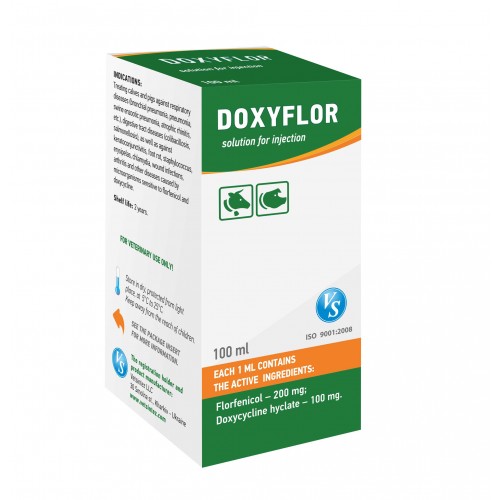
| Ingredients: | Doxycycline hyclate, Florfenicol |
| Application: | injecting |
| Type of formulation: | Antibiotic |
Description
Oily liquid, from yellow-brown to dark-brown color, with specific odor of the components.
Composition
Each1 mL contains the active ingredients:
- florfenicol – 200 mg
- doxycycline hyclate – 100 mg.
pharmacological properties
DOXYFLOR is a combined drug which consists of florfenicol and doxycycline.
Florfenicol - is an antibiotic from fenicol group. It’s active against gram-negative and gram-positive microorganisms including: Staphylococcus spp., Streptococcus spp., Enterobacter spp., E. coli, Pasteurella haemolytica, Pasteurella multocida, Pasteurella piscicida, Vibrio spp., Haemophilus somnus, Haemophilus parasuis, Fusobacterium necrophorum, Bacteroides melaninogenicus, A. pleuropneumoniae, Bordetella bronchiseptica, Salmonella spp., Klebsiella spp., Proteus spp., Shigella spp. and others.
Florfenicol active against most mycoplasma (Mycoplasma hyopneumoniae, Mycoplasma hyorhinis and others).
The mechanism of action of the preparation is binding to 70S ribosomes and blocking protein synthesis in bacteria cells.
Doxycyclin – bacteriostatic antibiotic that belongs to the group of tetracyclines. It affects the ribosome of bacteria, preventing protein synthesis. The preparation has a wide range of antimicrobial activity against gram-positive and gram-negative bacteria (Staphylococcus spp., Diplococcus pneumonia, Streptococcus spp., Haemophilus influenza, E. coli, Pneumococci, Bacillus antracis, Clostridium tetani, Clostridium perfringes, Listeria monocytogens, Actinomyces spp., Entirobacter spp ., Klebsiella spp., Salmonella spp., Shigella spp., Yersinia spp.), and mycoplasmas (Mycoplasma spp.), rickettsia (Rickettsia spp.) and chlamydia (Chlamydia).After intramuscular administration of florfenicol in cattle, its therapeutic plasma concentration is maintained for 48 hours. The half-life: 18.3 hours. In pigs, the half-life is 2.2 hours. Florfenicol reach its high concentrations in the lungs, kidney and bile as well as in muscles, intestine, heart, liver, spleen and in serum. Excreted, mainly, unchanged by glomerular filtration by the kidneys, as well as in the bile, by forming chelation bonds.
Doxycycline is widely distributed in body tissues and body fluids. Binding to plasma proteins amounts to 80-95%. Half of the dose is absorbed in 50 minutes. Maximum concentration in the blood is found after 2-4 hours, and the therapeutic concentration is maintained for 18-24 hours. Doxycycline is excreted from the body, mainly, in the bile.
Indications
Treating calves and pigs against respiratory diseases (bronchial pneumonia, pneumonia, swine enzootic pneumonia, atrophic rhinitis, etc.), digestive tract diseases (colibacillosis, salmonellosis), as well as against keratoconjunctivitis, foot rot, staphylococcus, erysipelas, chlamydia, wound infections, arthritis and other diseases caused by microorganisms sensitive to florfenicol and doxycycline.
Dosage
By intramuscular injection in doses:
Calves - 0.5 ml per 7.5 kg of animal body weight once a day
Pigs - 0.5 ml per 10 kg of animal body weight once per day.
The treatment course is 3 - 5 days.
Due to the possible local swelling and pain reaction upon administration in doses that exceed 2.5 ml in piglets, and 5 ml in pigs and calves, it is recommended to introduce the medication in several places.
Contraindications
Hypersensitivity to the components.
Do not use concurrently with thiamphenicol, chloramphenicol, antibiotics from penicillin group, cephalosporins, fluoroquinolones, since it might cause toxicosis.
Do not use together with sulfanilamide drugs.
Do not use in animals with their liver or kidneys severely affected.
Do not use simultaneously with calcium-containing drugs that can reduce the effect of the drug.
Do not use in animals during pregnancy and lactation, as well as bulls and boars intended for reproduction.
Precautions
Test the medication should be preliminarily tested in a small number of animals (7 - 8 heads). If no complication during 2 - 3 days, use the drag for the entire livestock population.
Pigs may only be slaughtered for human consumption after 34 days and calves - after 40 days from the last treatment.
How supplied
Neutral glass vials of 10-mL, 20-mL, 50-mL, 100-mL or 200-mL, closed by a rubber stopper and sealed with an aluminum cover.
Storage
In a dark, dry place, at 5ºС – 25ºС.
Keep out of reach of children.
Shelf life
2 years.
After opening the vial, it should be stored at temperature from 5ºС to 25ºС and should be used within 14 days.