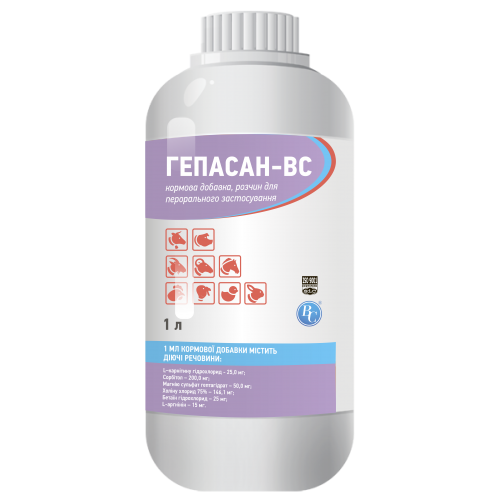
| Ingredients: | L-carnitine hydrochloride, sorbitol, magnesium sulfate heptahydrate, choline chloride , betaine hydrochloride, L-arginine |
| Application: | Orally |
| Type of formulation: | Feed additives |
Description
Solution for oral administration
Composition
1 ml of the feed mixture contains:
- L-carnitine (3а910) – 25,0 mg;
- betaine hydrochloride (3а925) – 25,0 mg;
- L-arginine (3с362) –
15,0 mg;
- L-methionine (3c305) – 10,0 mg;
- cyanocobalamin (vitamin B 12) (3a835) – 0,05 mg;
- sodium benzoate (1k301) – 0,25 mg,
- purified water.
Pharmacological properties
Hepasan-VS feed mix is a hepatoprotector with combined pharmacological properties of its individual components with a pronounced stimulating, protective and choleretic effect on the liver, which improves its function and metabolism, optimising basic physiological processes.
L-carnitine - accelerates metabolic processes, a product of lysine and methionine biosynthesis. L-carnitine is involved in the breakdown of excess fatty acids, enhancing their oxidation and transport to mitochondria, plays an important role in the transport of acetyl coenzyme A, increases the use of energy sources by cells, and helps to normalise metabolism in the body.
Betaine is a natural source of methyl groups and a hepatoprotector, which has a positive effect on metabolism and improves the condition of the intestinal epithelium, ensures more complete absorption of dietary energy, increases resistance to stress, has choleretic and lipotropic effects, activates metabolic methylation in the liver and synthesis of cell membrane phospholipids.
L-arginine - stimulates cellular metabolism, promotes neutralisation and excretion of ammonia, regulates blood sugar and reduces lactic acidosis caused by muscle exertion, activates the system of nitrogen-containing enzymes, synthesises nitroso group, providing the necessary tone of arteries.
Methionine is an essential amino acid with metabolic and hepatoprotective effects, is a donor of mobile metal groups, is necessary for choline synthesis, due to which deficiency the synthesis of phospholipids from fats and deposition of neutral fat in the liver are disrupted. It participates in the metabolism of sulfur-containing amino acids, in the synthesis of adrenaline, creatinine and other biologically important compounds, activates the action of hormones, vitamins (cyanocobalamin, ascorbic and folic acids), enzymes, proteins, reduces cholesterol concentration and increases the concentration of blood phospholipids. Methionine prevents excessive accumulation of fat-soluble compounds in liver cells and stimulates rapid elimination of various toxins, including heavy metals, from liver and kidney cells.
Vitamin B 12 (cyanocobalamin) is involved in haematopoiesis, synthesis of methionine and choline, nucleic acids, has lipotropic effect, stimulates protein synthesis function of the liver, activates synthesis of proteins, retinol, normalises feed digestion. It is 90% bound to proteins in the body. Penetrates the placental barrier.
The use of the feed mixture leads to an increase in the body's
endurance, improvement of heart function, reduction of subcutaneous fat,
increase in muscle mass due to the acceleration of metabolic processes in
cells, improved penetration of vitamins and minerals into cells and elimination
of decay products. The feed mixture reduces the risk of fatty liver, nephrosis,
myocarditis, prevents stress (thermal, transport, etc.), increases appetite and
feed absorption, improves digestion and fat absorption, which is especially
important during the period of intensive growth of animals and poultry.
Application
For liver detoxification and normalisation of liver function and regeneration after endo- and exotoxicosis, acceleration of its recovery during periods of intensive overload, normalisation of metabolism, improvement of heart function, increase of overall resistance and productivity, prevention of stress, acceleration of growth in calves, goats, sheep, pigs, horses, poultry, rabbits, dogs and cats.
Dosage
The feed mixture is
administered orally to horses, cattle, goats, sheep, pigs, poultry, rabbits for
5-10 days in the following doses:
-
fattening calves -
0.5-1 ml/l of liquid feed;
-
sheep, goats, pigs,
horses, rabbits - 0.5-1 ml/l of drinking water;
-
poultry - 0.5-0.75
ml/l of drinking water.
-
dogs,
cats - 0.5 ml (approximately 20 drops) of the feed mixture per 1 kg of body
weight per day, administered orally, directly, to the animal or mixed with food
or drinking water, for 7-10 days.
The duration of treatment may be
extended by a veterinarian's decision.
In case of increased physical activity, the dose for dogs may be increased to 1.0 ml of the feed mixture per 1 kg of body weight.
Contraindications
Not established.
Warnings
When working with the feed mixture, it is necessary to comply with generally
accepted sanitary and hygienic standards and rules at work.
Do not mix with vaccines administered with water.
Form of release
Neutral glass vials of NS-1, NS-2, USP-1, 10, 20, 30, 50 and 100 ml.
Polymer vials (canisters) of 1 and 5 litres, 10, 20, 25 litres.
Storage
Store in a dry, dark place at temperatures between 5 and 25°C.
Shelf life
2 years.
The shelf life after the first opening of the primary container, subject to storage conditions, is 28 days.
Name and location of the manufacturer(s)
Vetsintez Limited Liability Company
30 Taras Bobanych St., Kharkiv, 61001, Ukraine