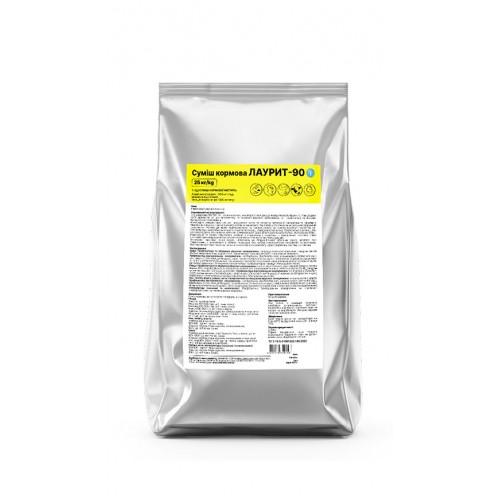
| Ingredients: | Alpha-monolaurin, wheat starch, calcium carbonate |
| Application: | ORALLY WITH FEED |
| Type of formulation: | feed mixture |
Description
Microgranulated powder from white to cream colour with a specific odour, characteristic of high-quality raw materials
Ingredients
1 g of the feed mixture contains:
- Alpha-monolaurin (13.6.2) – 900 mg;
- Wheat starch (13.3.2) – 50 mg;
- Calcium carbonate (11.1.1) – 50 mg;
- Moisture content is not more than 10 %.
Pharmacological properties
LAURIT-90 is a feed mixture that preserves and increases the productivity of animals and poultry due to its effective action in the prevention and treatment of viral diseases and the prevention and treatment of bacterial diseases.
Monolaurin is used to inhibit the growth and development of pathogenic microflora and works effectively in all parts of the digestive tract. As it is a covalent compound, its activity does not depend on the pH of the medium. It is active against gram-positive and gram-negative pathogenic bacteria: Escherichia coli, Salmonella spp., Clostridium perfringens, Streptococcus spp. Staphylococcus aureus, Enterococcus faecalis, Listeria monocytogenes, Mycoplasma synoviae, Campylobacter jejuni, Brachyspira hyodisenteriae, Helycobacter Pylori.
Monolaurin is similar in structure to glycerol and interacts with the cell wall membranes of gram-positive microorganisms, providing bacteriostatic and bactericidal effects.
Monolaurin inactivates lipid viruses by binding to the lipid-protein membrane of the virus, preventing its attachment and penetration into host cells, thereby preventing infection and replication.
Consumption of medium-chain fatty acids, such as monolaurin, helps in remodelling the gut microbiome, changing the distribution of beneficial bacteria where they are most needed. Monolaurin is also effective in inhibiting biofilm development, which can be characterised by a reduction in the number of viable bacteria associated with the biofilm, as well as a reduction in biofilm biomass.
Monolaurins are partially transported to the systemic circulation via the intestinal lymphatic system.
Application
Pigs:
Prevention of viral diseases:
- porcine reproductive and respiratory syndrome virus (PRRSv);
- epidemiological diarrhoea (PED);
- African swine fever (ASF);
- swine influenza.
Prevention of bacterial diseases:
- colibacillosis (Escherichia coli);
- salmonellosis (Salmonella spp.);
- clostridiosis (Clostridium perfringens);
- streptococcosis (Streptococcus spp.);
- staphylococcosis (Staphylococcus aureus);
- listeriosis (Listeria monocytogenes);
- mycoplasmosis (Mycoplasma synoviae);
- campylobacteriosis (Campylobacter jejuni);
- spirochete dysentery (Brachyspira hyodisenteriae);
- Helicobacter infection (Helycobacter Pylori).
Poultry:
Prevention of viral diseases:
- Avian influenza;
- Marek’s disease (MD);
- Newcastle disease (ND);
- Infectious bronchitis (IB);
- Egg drop syndrome (EDS).
Prevention of bacterial diseases:
- colibacillosis (Escherichia coli);
- salmonellosis (Salmonella spp.);
- clostridiosis (Clostridium perfringens);
- streptococcosis (Streptococcus spp.);
- staphylococcosis (Staphylococcus aureus);
- mycoplasmosis (Mycoplasma synoviae).
Horses, calves, lambs, dogs, cats:
Prevention of viral diseases:
- Epidemiological diarrhoea.
Prevention of bacterial diseases:
- colibacillosis (Escherichia coli);
- salmonellosis (Salmonella spp.);
- clostridiosis (Clostridium perfringens);
- streptococcosis (Streptococcus spp.);
- staphylococcosis (Staphylococcus aureus);
- listeriosis (Listeria monocytogenes);
- mycoplasmosis (Mycoplasma synoviae);
- campylobacteriosis (Campylobacter jejuni);
Aquaculture (salmon and non-salmon):
Prevention of bacterial diseases caused by monolaurin-sensitive microorganisms.
Dosage
The feed mixture is administered orally in the following doses:
Poultry:
Prevention:
Laying hens 300-500 g of feed mixture per 1 tonne of feed;
Broilers 300-600 g of feed mixture per 1 tonne of feed;
Turkeys 500-600 g of feed mixture per 1 tonne of feed.
In case of viral diseases, including avian influenza: 1500-2500 g of the feed mixture per 1 tonne of feed, for 14-21 days, until the symptoms disappear.
Horses, calves, lambs:
Prevention:
500-600 g of feed mixture per 1 tonne of feed.
Viral diseases: 800 g of feed mixture per 1 tonne of feed.
Pigs:
Prevention in all technological and age groups: 800-1000 g of the feed mixture per 1 tonne of feed.
Viral diseases, including African swine fever: 2500-3500 g of the feed mixture per 1 tonne of feed, for 14-21 days until the symptoms disappear.
Dogs, cats, aquaculture (salmon and non-salmon fish):
300-600 g of feed mixture per 1 tonne of feed;
Viral diseases: 800 g of the feed mixture per 1 tonne of feed
Contraindications
None.
Cautions
Follow sanitary and hygienic norms and rules.
Packaging
Polyethylene film bags of 100, 500 g and 1 kg and bags of 5, 10, 20 and 25 kg.
Storage conditions
Store in a dry dark place at temperatures from 0 to 25°C and relative humidity not exceeding 70%.
Shelf life
2 years.
Shelf life after the first opening of the primary container is 28 days subject to storage conditions.
For veterinary use only!
Holder of the technical specifications and manufacturer of the finished product
Vetsintez Limited Liability Company
61001, 30 Bobanycha Tarasa St., Kharkiv, Ukraine
Registration number of the production capacity: d-UA-20-8