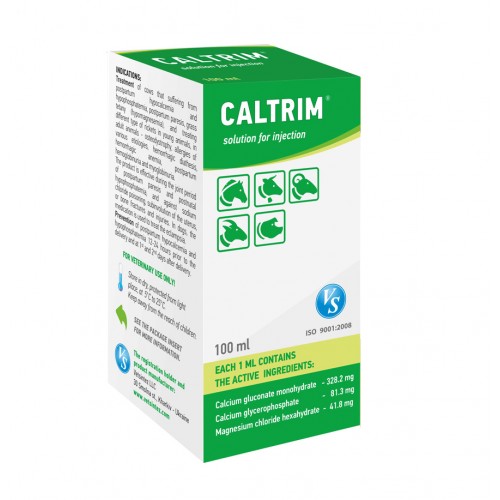
| Ingredients: | Calcium gluconate monohydrate, Calcium glycerophosphate, Magnesium chloride hexahydrate |
| Application: | injecting |
| Type of formulation: | vitamins |
Discription
Solution from colorless or light-yellow color, practically odorless.
Сomposition
Each 1 ml contains the active ingredients:
- calcium gluconate monohydrate - 328.2 mg
- calcium glycerophosphate - 81.3 mg
- magnesium chloride hexahydrate - 41.8 mg.
Pharmacological properties
ATC-vet classification code: QA12CX99 other mineral agents. Combinations.
Calcium is actively involved in the formation of bone tissue in the composition of hydroxyapatite crystals. In case of insufficient receipt of calcium and phosphorus, the bones become soft and their growth is violated, developing rickets in young and osteodystrophy in adult animals. Calcium is necessary for maintaining the functions of the nervous system: calcium ions stimulate the release of acetylcholine and its interaction with acetylcholine receptor, promote the interaction of actin and myosin, i.e. the muscular fibers contraction. The smooth muscle cells in the myocardium and conduction system of the heart, the calcium ions are directly involved in the generation of nerve impulses, normalises the myocardial tonus and strengthen the contraction of the heart. Calcium is involved in blood coagulation and stimulates the conversion of prothrombin to thrombin and fibrinogen to fibrin, the transport function of cell membranes. By reducing the permeability of the capillary walls, it shows anti-inflammatory, anti-exudative, anti-allergic and anti-sensibilizing actions, restores the balance between monovalent and divalent cations.
Phosphorus is one of the structural elements of the organism. All the synthetic processes related the growth and formation of products (forming the skeleton, increase muscle mass, milk Synthesis), are carried out with the participation of phosphoric acid compounds. Phosphorus is a part of the structure of nucleic acids, which are carriers of genetic information, regulate protein biosynthesis and immunity. Phosphorus is required for phosphorylation and oxidation of important substrates in metabolic processes. Phosphorus-macroergic compounds - among which the ATP (adenosine triphosphate) - are the universal accumulators and donors of energy.
Magnesium is essential for bone formation; it is a part of hydroxyapatite crystals, thereby increasing the strength of bones and teeth. Magnesium affects the central nervous system: accelerating the breakdown of acetylcholine, it inhibits the excitability of nerve endings. Along with calcium, is involved in muscle contraction. Magnesium, like potassium, is a major cation of the intracellular environment. In cells, it activates the Krebs cycle enzymes and nucleic acids.
Indications
Treatment of cows that suffering from postpartum hypocalcemia and hypophosphatemia, postpartum paresis, grass tetany (hypomagnesemia), and treating different type of rickets in young animals, and in adult animals - osteodystrophy, allergies of various etiologies, hemorrhagic diathesis, hemorrhagic anemia, postpartum hemoglobinuria and myoglobinuria.
The product is effective during the joint period of postpartum paresis and postnatal hypophosphatemia, and against sodium chloride poisoning, subinvolution of the uterus, or bone fractures and injuries. In dogs, the medication is used to treat the eclampsia.
The medication is used for preventing postpartum hypocalcemia and hypophosphatemia 12-24 hours before delivery and at first and second days after delivery.
Dosage
Caltrim is injected intravenously, intramuscularly or subcutaneously at doses of:
| Animal species | The dose (in ml) | Route of administration |
| Horses (with body weight of 500 kg) | 80 – 100 | IV |
| Cattle (with body weight of 500-700 kg) | 80 – 215 | IV, IM or SC |
| Calves (with body weight of 100 kg) | 20 – 30 | IV, IM or SC |
| Sheep, goats | 15 – 25 | IV, IM or SC |
| Pigs | 15 – 25 | IV, IM or SC |
| Piglets | 2 – 3 | IV, IM or SC |
| Dogs | 1.5 – 5 | IV, IM or SC |
IV – intravenously
IM – intramuscularly
SC – subcutaneously
If necessary, the dose can be repeated after 24 hours.
The drug is injected slowly, preheated to 35 – 37 °C.
Side effects
At the injection site may occur some irritation.
Tachycardia, agitation may be observed.
Contraindications
Do not use the medication in case of hypercalcemia, severe renal dysfunction, excessive nervous irritability, ventricular fibrillation, hypersensitivity to the components.
Precautions
At the same spot to large animal subcutaneously inject maximum 50 ml, intramuscularly - not more than 25 ml. For pigs, sheep and goats: intramuscularly in the same place do not inject more than 15 ml.
The medication is used with extreme caution in animals with heart or kidney diseases.
Intravenous injection should be done slowly to avoid arrhythmia and heart block!
During intramuscular or subcutaneous injection this risk is much lower.
How supplied
Neutral glass vials of 10-mL, 20-mL, 50-mL; 100-mL; and 200-mL, closed by a rubber stopper and sealed with an aluminum cover. Secondary package: cartons.
Storage
In a dry, dark place at a temperature of from 5 to 25 ° C.
Shelf life
2 years.
After opening, the preparation should be used within 28 days, provided that the medicine is selected aseptically and stored at dark place between 10°C and 15°C.