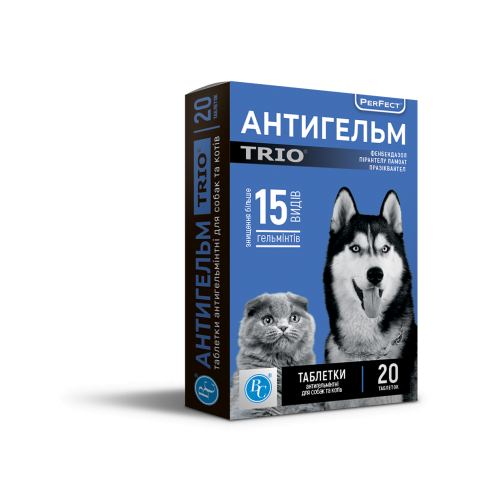
| Ingredients: | fenbendazole, pyrantel pamoate (embonate), praziquantel |
| Application: | orally |
| Type of formulation: | Anthelmintic |
DESCRIPTION
Tablets are round or heart-shaped, white to yellow in color, with a characteristic odor.
COMPOSITION
One tablet (weighing 800 mg) contains the active ingredients:
- fenbendazole – 200 mg
- рyrantel pamoate (imbonate) – 144 mg
- рraziquantel – 50 mg
Auxiliary substances: Potato starch, calcium stearate, flavoring, lactose.
PHARMACOLOGICAL PROPERTIES
ATCvet QP52, veterinary antihelmintic drugs, ATCvet QP52AA01 – praziquantel, QP52AF02 – pyrantel, combinations.
ANTIGELM TRIO is a combination product containing fenbendazole, pyrantel pamoate, and praziquantel. It has a broad spectrum of antihelmintic activity on various stages of development of roundworms and tapeworms in dogs and cats, based on the pharmacological properties of its components.
Fenbendazole (a member of the benzimidazole group) inhibits the polymerization of tubulin proteins into microtubules, disrupting the transport and intracellular delivery of nutrients (adenosine triphosphate and glucose), which leads to the death of parasites due to exhaustion.
Fenbendazole has a universal antihelmintic effect against nematodes, cestodes, trematodes of the digestive and respiratory systems, and also exhibits ovicidal activity (destroys helminth eggs). It reduces pasture contamination and the likelihood of reinfection in animals.
Fenbendazole is frequently the primary treatment for giardiasis in dogs. It inhibits microtubule formation in the parasite’s cell and prevents the removal of waste and absorption of nutrients. Parasite cells quickly become exhausted, leading to parasite death.
Fenbendazole is non-cumulative, non-embryotoxic, non-mutagenic, and non-allergenic, and is considered a low-toxicity substance.
When taken orally, fenbendazole is absorbed in the gastrointestinal tract and penetrates into organs and tissues. It is excreted mainly in urine and feces, either unchanged or in the form of metabolites.
Pyrantel pamoate (a member of the tetrahydropyrimidine group) is active against both immature and adult nematodes. It acts on their cholinergic receptors, leading to irreversible spastic paralysis of the parasites. Pyrantel pamoate is minimally absorbed in the intestines, which prolongs its antihelmintic effect. It is mainly excreted unchanged (up to 93%) in the feces.
The combination of fenbendazole and pyrantel in this product has a synergistic effect against nematodes in dogs and cats, including Toxocara canis, Toxocara cati, Toxascaris leonina, Ancylostoma spp., Uncinaria spp., Trichuris vulpis, and also against Giardia spp.
Praziquantel – a pyrazinoquinolone derivative – is effective against cestodes and trematodes in dogs and cats, including Taenia species, Dipylidium caninum, Echinococcus granulosis, Echinococcus multilocularis, Mesocestoides spp., Diphyllobothrium latum, Opisthorchis felineus, and Alaria alata. Praziquantel is rapidly absorbed by the parasite's surface and spreads throughout its body. Studies show that praziquantel destroys the external covering (tegument) of the parasite. This results in an almost immediate contraction of the parasite's muscles and rapid vacuolization of the tegument. The rapid contraction is caused by changes in the parasite's cell membrane permeability to divalent cations, especially calcium. Depolarization of neuromuscular ganglionic blockers, disruption of glucose transport, and microtubular dysfunction in cestodes leads to muscle innervation failure, paralysis, and death of the parasite.
After oral administration, praziquantel is almost completely absorbed from the gastrointestinal tract and reaches its maximum concentration in plasma within 1-3 hours. Its bioavailability is about 80%. Praziquantel is metabolized in the liver to inactive forms and is excreted in the bile. It is eliminated from the body within 48 hours via urine and in small amounts in feces.
This medication, when used at the recommended doses, does not exhibit sensitizing, embryotoxic, or teratogenic effects.
INDICATIONS
Deworming of dogs and cats in case of infection with:
Nematodes (larval, juvenile, and adult stages): Toxocara canis, Toxocara cati (syn. Toxocara mystax), Toxascaris leonina, Ancylostoma spp., Uncinaria spp.
Cestodes (pre-imaginal and imaginal stages): Dipylidium caninum, Taenia spp., Echinococcus spp., Mesocestoides spp.
Trematodes: Opisthorchis felineus, Alaria alata, Pseudamphistomum truncatum, Echinochasmus perfoliatus.
DOSAGE AND ADMINISTRATION
Recommended dose: 1 tablet per 10 kg body weight of the animal (20 mg fenbendazole, 14.4 mg pyrantel pamoate, and 5 mg praziquantel per 1 kg of body weight).
Doses depending on body weight:
|
Animal body weight, kg |
Number of tablets, pcs. |
|
1-2.5 kg |
1/4 tablet |
|
2.5-5 kg |
1/2 tablet |
|
5-10 kg |
1 tablet |
|
10-15 kg |
1 1/2 tablets |
|
15-20 kg |
2 tablets |
|
20-30 kg |
3 tablets |
|
30-40 kg |
4 tablets |
|
40-50 kg |
5 tablets |
The tablets should be given with food or directly administered. No prior fasting or special feeding regimen is required.
Tablets can be divided into halves and quarters for animals weighing less than 10 kg.
For therapeutic deworming, a single dose is sufficient. If necessary, repeat the treatment after 10-14 days.
For prophylactic deworming, give once every quarter, as well as before mating and 12-14 days before vaccination.
CONTRAINDICATIONS
Hypersensitivity to the components of the product.
Do not use in puppies under 4 weeks old.
Do not use in kittens under 6 weeks old.
Do not use in females one week before or two weeks after giving birth.
Do not use in animals with infectious diseases, weakness, or depletion.
Do not use in animals with impaired kidney or liver function.
Do not use in conjunction with piperazine, levamisole, organophosphates, or other drugs with cholinergic activity.
WARNINGS
Use according to the instructions.
Adhere to the recommended dosages.
There are no clinical signs of overdose when using the product at the recommended doses.
The product can be used in lactating females once the puppies are 4 weeks old and kittens are 6 weeks old.
If the recommended dose is increased 3-5 times in dogs, or the treatment period is extended twice as long as recommended, no clinical signs of overdose are observed.
Cats are more sensitive, and in case of overdose, symptoms such as depression, vomiting, and diarrhea may occur, but these symptoms usually pass without therapeutic intervention. No specific antidotes are available.
FORM OF RELEASE
Packets containing 1 tablet. Secondary packaging – cardboard boxes containing 20 packets of tablets. Blister packs containing 10 tablets, packed together with instructions in a cardboard box.
STORAGE
Store in a dry, dark place, out of reach of children and animals, at a temperature between 5°C and 25°C.
SHELF LIFE
3 years.
For veterinary use only!