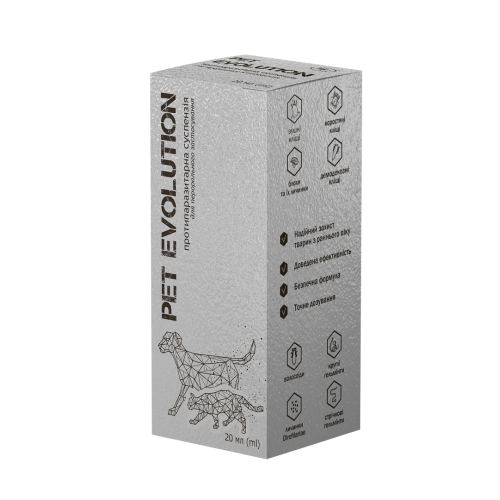
PET EVOLUTION (antiparasitic suspension for dogs and cats 20 ml)
| Ingredients: | lufenuron, praziquantel, moxidectin |
| Application: | orally |
| Type of formulation: | antiparasitic |
Description
Suspension ranging from light brown to light pink in colour, with a specific odour characteristic of the excipients; separates on storage, with sediment.
Composition
1 ml of suspension contains the active substances:
- lufenuron — 20 mg
- praziquantel — 10 mg
- moxidectin — 0,6 mg
Excipients: bentonite; xanthan gum, sodium benzoate, propylene glycol, sucralose, flavouring, purified water.
Pharmacological Properties
ATCvet QP53 ectoparasiticides, insecticides and repellents (QP52 anthelmintic veterinary preparations, QP52AA51 praziquantel, QP54AB02 — moxidectin, combinations).
The combination of lufenuron, moxidectin, and praziquantel contained in PET EVOLUTION suspension provides a broad spectrum of antiparasitic activity in dogs and cats against ectoparasites: fleas (Ctenocephalides spp., Pulex irritans), sarcoptoid mites (Otodectes cynotis, Sarcoptes canis, Notoedres cati), trombidiform mites (Demodex spp.), ixodid ticks (Dermacentor spp., Rhipicephalus spp., Ixodes spp.), and endoparasites: Dipylidium caninum, Taenia spp., Echinococcus granulosus, Alveococcus multilocularis, Mesocestoides lineatus, Diphyllobothrium latum, Toxocara canis, Toxocara cati (Toxocara mystax), Toxascaris leonina, Ancylostoma caninum, Uncinaria stenocephala, Trichuris vulpis, as well as the larval developmental stages of Dirofilaria immitis and Dirofilaria repens.
Lufenuron (a benzoylphenylurea group compound) is a broad-spectrum insecticide, particularly active against flea species Ctenocephalides spp. and Pulex irritans, with enhanced larvicidal and contact ovicidal activity. The mechanism of action involves inhibition of chitin synthesis, which is the principal component of insect exoskeletons; as a result, larvae are unable to form a new cuticle during moulting and die. Entering the insect's body via the blood of the animal, and subsequently into their eggs, lufenuron blocks the process of chitin formation, causing larvae to die as a result of disrupted cuticle formation, thereby preventing the emergence of the next generation of fleas.
Lufenuron is rapidly absorbed in the stomach (adequate absorption is achieved when the stomach contains food), is eliminated slowly, and ensures a high concentration of the compound in the animal's body for one month.
Praziquantel is a synthetic compound, a pyrazino-isoquinoline derivative, with effective action against cestodes and trematodes. Praziquantel is very rapidly absorbed through the surface of the parasite and distributed throughout its body. In vitro and in vivo studies demonstrate that praziquantel disrupts the outer tegument of the parasite. This results in almost instantaneous tetanic contraction of the parasite's musculature and rapid vacuolisation of the tegument. This rapid contraction is explained by altered permeability of the parasite's cell membranes to divalent cations, particularly calcium. Depolarisation of neuromuscular junctions, disruption of glucose transport and microtubular function in cestodes leads to impairment of muscular innervation, paralysis, and death of the parasite. Praziquantel is rapidly absorbed in the gastrointestinal tract, reaches maximum plasma concentration within 1–3 hours, distributes into the organs and tissues of the animal; binds to serum proteins (70–80%), is partially metabolised in the liver, excreted into the intestine and eliminated from the body primarily in urine (up to 80%) and in negligible amounts in faeces.
Moxidectin is a second-generation macrocyclic lactone of the milbemycin group with pronounced activity against many endo- and ectoparasites. The mechanism of action on the parasite involves stimulation of the release of the inhibitory neurotransmitter gamma-aminobutyric acid (GABA), resulting in blockade of impulse transmission between interneurons and excitatory motor neurons of the parasite's nerve trunk, leading to paralysis and death of the parasite. It is eliminated from the body primarily unchanged over 6 weeks.
At recommended doses, the medicinal product does not exhibit sensitising, embryotoxic, or teratogenic effects.
Indications
For the treatment and prevention of mixed parasitic infestations in dogs and cats, puppies and kittens, caused by:
- fleas: Ctenocephalides spp., Pulex irritans; destruction of flea eggs and larvae;
- ixodid ticks: Dermacentor spp., Rhipicephalus spp., Ixodes spp.;
- sarcoptoid mites: ear mites (Otodectes cynotis), feline scabies mite (Notoedres cati), sarcoptic mange mite (Sarcoptes canis);
- trombidiform mites: Demodex canis, D. cati, D. gatoi;
- cestodes at preimaginal and imaginal stages: Dipylidium caninum, Taenia spp., Echinococcus granulosus, Alveococcus multilocularis, Mesocestoides spp., Diphyllobothrium latum;
- gastrointestinal nematodes: Toxocara canis, Toxocara cati (Toxocara mystax), Toxascaris leonina, Ancylostoma spp., Uncinaria spp., Trichuris vulpis;
- prevention of flea allergy dermatitis (FAD);
- prevention of dirofilariosis: Dirofilaria spp. (microfilariae, L3 and L4 stages).
Dosage and Administration
The product is intended for oral administration (per os), individually, during the morning feeding with a small amount of food, or administered directly into the mouth onto the back of the tongue using a dosing syringe, at a minimum therapeutic dose of 1 ml of product per 2 kg body weight (equivalent to 10 mg lufenuron, 5 mg praziquantel, 0,3 mg moxidectin per 1 kg body weight).
Shake the bottle with suspension before use!
For the treatment and prevention of siphonapterosis (Ctenocephalides spp., Pulex irritans), flea allergy dermatitis (FAD), and ixodidosis (Dermacentor spp., Rhipicephalus spp., Ixodes spp.), the product is administered to dogs and cats once monthly, depending on the epidemiological situation. A single administration of the suspension prevents re-infestation for 4–6 weeks throughout the entire season of ectoparasite activity.
The insecticidal effect of the product manifests within 24 hours, reaching its maximum level within 48 hours. The acaricidal effect manifests within 24 hours; accordingly, treatments should be administered no later than 24 hours before the anticipated walk of the animal in areas where ixodid ticks may be present (parks, squares, forests).
For the treatment of otodectosis and notoedric mange, the product is administered as a single dose.
Repeat administration may be prescribed one month after the first dose based on the results of clinical assessment and laboratory testing for sarcoptoid mange (skin scrapings).
For the treatment of sarcoptic mange, the product is administered once monthly for two months. Further use of the product should be based on clinical assessment and laboratory testing for sarcoptic mange (skin scrapings).
For the treatment of demodicosis, the product is administered monthly until two consecutive negative laboratory test results for the detection of different developmental stages of Demodex (skin scrapings: examination for live and dead mites) are obtained at one-month intervals. In more severe cases of the disease, treatment may be extended. Treatment of animals should be carried out in a comprehensive manner using pathogenetic and symptomatic medicinal agents.
For cestodosis and gastrointestinal nematodosis, the product is administered as a single dose as indicated; at high infestation intensity, re-deworming is recommended after 10–14 days.
For prophylactic purposes, the product is administered to animals at the therapeutic dose once every 3 months, as well as 10–14 days before each vaccination.
For prevention of ixodid tick infestation and prevention of dirofilariosis (microfilariae L3 and L4 stages) in disease-endemic regions, the product must be administered monthly (for at least 6 months), beginning treatment one month before the start of the active arthropod season and ending no earlier than one month after its conclusion (spring–summer–autumn period). The product does not eliminate immature and adult Dirofilaria but reduces the number of microfilariae (larvae) circulating in the blood and may be used in infected animals.
Contraindications
Do not use in animals with known hypersensitivity to any of the product components, including a history of severe hepatic or renal impairment.
Do not use in debilitated animals or animals suffering from infectious diseases.
Do not use in females during pregnancy and lactation.
Do not use in puppies and kittens under 6 weeks of age and weighing less than 1,5 kg.
Precautions
The product was well tolerated in dogs with ABCB1 gene mutation (MDR1 −/−). However, in such sensitive breeds (Collie, Old English Sheepdog, Shetland Sheepdog, related breeds and other sensitive dogs), the recommended dosage must be strictly observed and treatment should be carried out under the supervision of a veterinarian.
Use only accordingly to the benefit-risk assessment by the responsible veterinarian. This veterinary medicinal product is not effective against the adult stage of Dirofilaria spp.
Adverse reactions and complications during use of the product in accordance with these instructions are generally not observed. In some animals, gastrointestinal disturbances and increased salivation may occur; these resolve spontaneously and do not require the administration of medicinal agents.
In cases of product overdose, the animal may exhibit depression, loss of appetite, excessive salivation, and gastrointestinal disturbance. In such cases, enterosorbents and symptomatic therapy agents should be administered.
The product should not be used concurrently with other antiparasitic agents containing macrocyclic lactones, with piperazine, or with products that inhibit cholinesterase.
Hands should be washed with soap after handling the product.
When working with the product, observe the basic rules of hygiene and safety applicable to work with veterinary products.
In the event of accidental ingestion of the product by a human, nervous system disorders may occur; in such cases, medical attention should be sought immediately (carry the package leaflet or product label).
Presentation
Glass or polymer bottles, sealed with plastic caps, of 5, 10, 15, 20, 30, and 50 ml, packaged in cardboard boxes.
Storage
Store the product in the original packaging in a dry, light-protected place inaccessible to children and animals at a temperature of 5 to 25 °C. Shelf life after first opening the immediate packaging: store in a dark place at a temperature of 5 to 10 °C for 90 days.
Shelf life
18 months.
For veterinary use only!