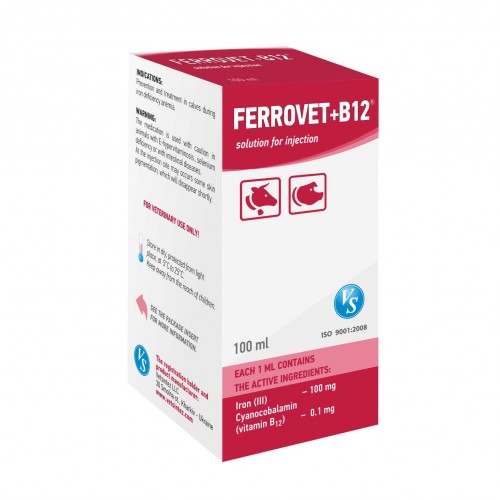
FERROVET+B12 (solution for injection)

FERROVET+B12 (solution for injection)
Ingredients: Vitamin B12 (cianocobalamine), Iron (III) hydroxide dextrin complex 
Application: Injection
Type of formulation: vitamins

Description

A viscous, transparent, dark brown liquid, practically free from visible particles, with a faint characteristic odour.

Composition

Each 1 ml of the product contains the following active substances (mg):
- iron (as iron (III) hydroxide dextran complex) - 100,0 mg
- cyanocobalamin (Vitamin B12) – 0,1 mg.
Excipients: sodium chloride, water for injections.

Pharmacological Properties

ATC-vet classification code: QB03AC Anti-anaemic preparations. Parenteral iron (III) preparations.

A combination product whose action is determined by its constituent components.

The iron (III) hydroxide complex with low-molecular-weight dextran stimulates the haematopoietic system, increases haemoglobin levels, raises the erythrocyte count, replenishes iron deficiency, and improves performance of food-producing animals.

Iron is an essential component of haemoglobin, myoglobin, and certain other enzymes. Its primary role involves electron transfer, oxygen molecule transport, and oxidative metabolism during tissue growth and proliferation. As a constituent of enzymes, iron acts as a catalyst for oxidation, hydroxylation, and other vital metabolic processes.

Iron deficiency occurs when dietary intake is insufficient, when absorption in the gastrointestinal tract is impaired, when demand is increased (accelerated growth, pregnancy), or as a consequence of blood loss.

In blood plasma, iron is transported by the β-globulin transferrin, which is synthesised in the liver. Each transferrin molecule binds two iron atoms. In complex with transferrin, iron is carried into body cells, where it reversibly binds to ferritin and is utilised for the synthesis of haemoglobin, myoglobin, and certain enzymes.

Following parenteral administration of iron dextran, haemoglobin levels rise more rapidly than after oral administration of iron salts, despite the absence of any dependence of iron incorporation kinetics on the route of administration.

After intramuscular injection, iron dextran is absorbed primarily via the lymphatic system and diffuses into the bloodstream in approximately 3 days. Bioavailability data are unavailable; however, it is known that a considerable proportion of the complex is not absorbed from muscle tissue over an extended period. The T½ of iron dextran is 3–4 days.

The iron dextran complex is sufficiently large to preclude renal elimination. The complex is stable, and under physiological conditions no release of ionic iron occurs.

Cyanocobalamin stimulates haematopoietic processes, activates creatine synthesis, fat metabolism, and the biosynthesis of methionine and other metabolic processes; it is essential for DNA synthesis. Vitamin B12 participates in the synthesis of methyl groups required for the synthesis of purine and pyrimidine bases — constituents of nucleic acids — and in the production of the coenzyme methylcobalamin, which is necessary for methylation reactions. It plays a significant role in haematopoiesis, red bone marrow function, and the biosynthesis of nucleic acids. Vitamin B12 contains cobalt. Resynthesis of the essential amino acid methionine in the body is mediated by Vitamin B12. Cyanocobalamin influences animal growth and the activation of protein metabolism, and promotes amino acid assimilation.

When administered parenterally, Vitamin B12 rapidly enters the systemic circulation. In the blood, it binds to transcobalamins I and II, which transport it to the tissues. It is deposited primarily in the liver. The time to maximum concentration (Tmax) following intramuscular administration is approximately 1 hour. In the body, it is 90% protein-bound. It is excreted via the kidneys and bile, and crosses the placental barrier.

Indications

For the prevention and treatment of iron-deficiency anaemia in piglets.

Dosage and Administration

Administer by intramuscular injection. Piglets at 3 days of age: 2 ml per animal. Pull the skin laterally at the injection site prior to injection to prevent leakage.
During cold weather, the product should be warmed to 37–38 °C prior to administration.

Contraindications

Do not use in cases of hypersensitivity to the active substances or to any of the excipients.
Do not use in animals with Vitamin E and/or selenium deficiency.
Do not use in animals with diarrhoea.
Do not use in combination with tetracyclines.

Warnings

Adverse effects
In rare cases, death of piglets is possible in breeds genetically susceptible to iron preparations, as well as in animals with Vitamin E and/or selenium deficiency.
Transient discolouration of tissue at the injection site is possible.

Overdose (symptoms, emergency measures, antidotes)
Overdose may cause peripheral vascular collapse, leading to depression, bradycardia or tachycardia, hypotension, cyanosis of the mucous membranes, ataxia, and even coma.
Occasionally, signs of acute toxicity may be absent for 12–48 hours following administration, after which a critical phase may develop, characterised by pulmonary oedema, vasomotor collapse, cyanosis, acute hepatic failure, coma, and death of the animal.
In cases of overdose, deferoxamine may be used as an antidote; it forms water-soluble chelate compounds with iron that are rapidly eliminated by the kidneys.

Withdrawal period
Meat — 0 days.

Presentation

Nature and composition of immediate packaging: Type I or Type II neutral glass vials of 10, 20, 50, 100, and 200 ml, closed with rubber stoppers and sealed with aluminium crimp caps, packed in cardboard cartons.

Storage

Store in a dry, dark place, out of reach of children, at a temperature of 5 to 25 °C.

Shelf life 

2 years.
Shelf life after first opening the immediate packaging: 14 days, provided that aseptic withdrawal and storage in a dark place at a temperature of 5 to 25 °C are maintained.
For veterinary use only!

Write a review