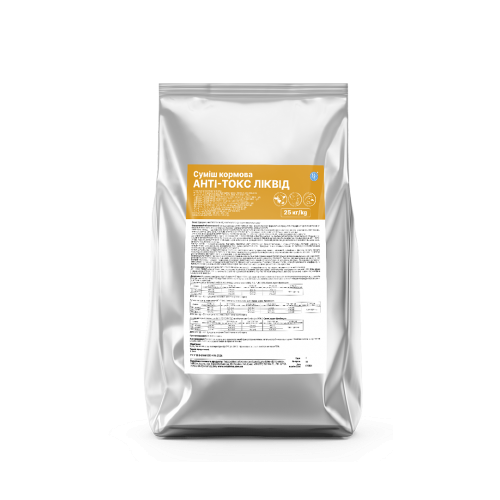
| Ingredients: | Enzymes, Bacillus bacteria, soluble starch, corn dextrin |
| Application: | Orally |
| Type of formulation: | feed mixture |
Description
Yellowish to brownish water-soluble powder
Composition
1 g of feed mixture contains:
Enzymes produced by Bacillus bacteria deactivate a wide range of mycotoxins: AFB, ZEA, DON, T-2, FUM, OTA:
- aflatoxin deactivating enzyme AFV - not less than 20,000 IU/g
- Zearalenone deactivating enzyme ZEA - not less than 15,000 IU/g;
- FUM deactivating enzyme - not less than 40,000 IU/g;
- vomitoxin-degrading enzyme DON - not less than 50,000 IU/g;
- T2 toxin degrading enzyme - not less than 40,000 IU/g;
- OTA degrading enzyme - not less than 30,000 IU/g;
- Bacillus licheniformis (4a1700i) - not less than 2.0*109CFU;
- Bacillus subtilis (4a1700i) - not less than 3.0*109CFU;
- soluble starch (13.3.1) - 0.10 g;
- corn dextrin (13.3.5) - 0.10 g.
Pharmacological properties
Feed mixture ANTI-TOX LIQUID belongs to enzyme products of specific action and probiotics of the IV generation and contains spore-forming bacteria Bacillus licheniformis, Bacillus subtilis.
ANTI-TOX LIQUID is a completely biological product containing enzymes that can degrade all major mycotoxins for animals, including AFB, ZEA, DON, T-2, FUM, OTA and others. The decomposition efficiency is 99.8% for animals and poultry.
Meanwhile, it improves the animal's immunity, partially restores liver cells. Most clinical manifestations may disappear.
The auxiliary components of the ANTI-TOX LIQUID feed mixture are Bacillus subtilis and Bacillus licheniformis (live bacteria). The primary and secondary metabolites of these live bacteria are small protein molecules with a detoxifying effect. The ANTI-TOX LIQUID feed mixture works by breaking down the epoxy groups of mycotoxins, breaking down toxic substances into non-toxic metabolites, it can replace 50% of the dose of probiotics.
Bacillus subtilis is a spore-forming bacterium that inhibits the growth of pathogenic gram-positive and gram-negative bacteria by competitively displacing them without causing resistance. It produces lysozyme and peptides with antibiotic properties, as well as a large number of enzymes in the intestine.
Bacillus licheniformis is a spore-forming bacterium that synthesises vitamins in the digestive tract, such as vitamin K, riboflavin, and folic acid. Helps to maintain acid-base balance in the large intestine, produces lactic acid, promotes absorption of nutrients. It inhibits the growth of pathogenic microorganisms and stimulates the growth of lactobacilli.
The symbiosis of these bacteria improves the state of intestinal microflora, reduces the risk of bacterial diseases due to natural displacement of opportunistic bacteria, stimulating the growth of lactic acid bacteria. The high enzymatic activity of these bacteria supports digestion processes, improves feed digestion and nutrient absorption. Due to stimulation of phagocytic activity of monocytes and neutrophils, enhancement of functional activity of macrophages, induction of endogenous interferon and increase in the content of gamma-globulin fraction of blood, nonspecific resistance of the organism is enhanced.
Application
ANTI-TOX LIQUID can prevent diseases of poultry and animals caused by mycotoxins.
ANTI-TOX LIQUID can also be used as a treatment for the degradation of mycotoxins and removal of toxins, to increase the body's natural resistance and the level of immunity during and after vaccinations, to protect the body of animals from the effects of stress of various kinds.
Dosage
The recommended doses of the feed mixture when working with different mycotoxins at different levels and the results of the control effect (AS: absolutely safe; RS: relatively safe, because there is a possibility of cumulative poisoning; OI: obvious improvement) are given in the following tables:
Dosage of the feed mixture ANTI-TOX LIQUID for mycotoxin AFB, T-2, FUM, OTA:
Pigs, broiler chickens:
With water |
0-10 ppb concentration of mycotoxins |
10-20 ppb concentration of mycotoxins |
20-30 ppb concentration of mycotoxins |
30-40 ppb concentration of mycotoxins |
|
100 g/ton |
93% (AS) |
89% (AS) |
82% (RS) |
75% (OI) |
|
150 g/ton |
97% (AS) |
93% (AS) |
87% (AS) |
77% (RS) |
|
350 g/ton |
99% (AS) |
96% (AS) |
92% (AS) |
83% (AS) |
CATTLE: 30 g - 50 g of feed mixture per 1 ton of feed.
Dosage of the mixture of feed ANTI-TOX LIQUID for mycotoxin ZEA:
Pigs, broiler chickens:
|
0-100 ppb concentration of mycotoxins |
100-200 ppb concentration of mycotoxins |
200-300 ppb concentration of mycotoxins |
300-500 ppb concentration of mycotoxins |
500-1000 ppb concentration of mycotoxins |
|
|
89% (AS) |
86% (AS) |
78% (RS) |
70% (OI) |
52% (OI) |
|
150 g/ton |
93% (AS) |
91% (AS) |
87% (AS) |
72% (RS) |
60% (OI) |
|
350 g/ton |
96% (AS) |
93% (AS) |
89% (AS) |
80% (AS) |
69% (OI) |
CATTLE: 30 g -50 g of feed mixture per 1 ton of feed.
Dosage of the mixture of feed ANTI-TOX LIQUID for mycotoxin Vomitoxin (DON):
Pigs, broiler chickens:
With water |
0-1000 ppb concentration of mycotoxins |
1000-1500 ppb concentration of mycotoxins |
1500-2000 ppb concentration of mycotoxins |
2000-3000 ppb concentration of mycotoxins |
|
|
81% (AS) |
76% (AS) |
72% (RS) |
57% (OI) |
|
150 g/ton |
86% (AS) |
80% (AS) |
86% (RS) |
64% (OI) |
|
350 g/ton |
91% (AS) |
86% (AS) |
81% (AS) |
69% (RS) |
CATTLE: 30 g -50 g of feed mixture per 1 ton of feed.
Contraindications
Not established.
Warnings
When working with the feed mixture, it is necessary to comply with generally accepted sanitary and hygienic standards and rules at work. Use only for the intended purpose.
Form of release
1 kg bags and 5, 10, 20 and 25 kg sacks.
Storage
Store in a dry, dark place at temperatures between 5°C and 30°C and relative humidity not exceeding 75%.
Shelf life
2 years
Name and location of the manufacturer(s)
Vetsintez Limited Liability Company
30 Smolna St., Kharkiv, 61001, Ukraine