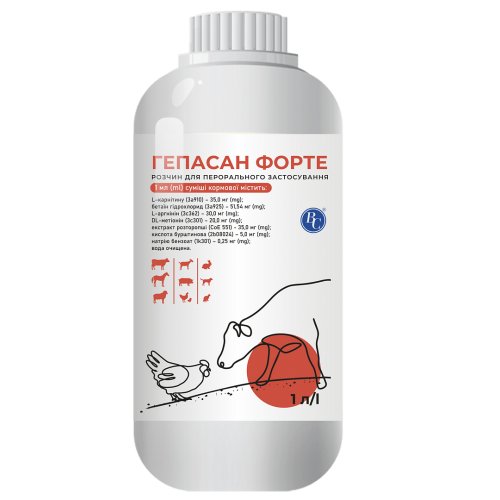
HEPASAN FORTE (feed mixture)
| Ingredients: | Sorbitol, Betaine hydrochloride, Propylene glycol, L-carnitine, Milk thistle extract, L-arginine, DL-methionine, Succinic acid, Sodium benzoate, Purified water |
| Application: | Orally with food |
| Type of formulation: | feed additive |
Description
Oral solution.
Composition
1 ml of the feed mixture contains:
- sorbitol – 160,0 mg;
- betaine hydrochloride – 51,54 mg;
- propylene glycol – 50,0 mg;
- L-carnitine – 35,0 mg;
- milk thistle extract – 35,0 mg;
- L-arginine – 30,0 mg;
- DL-methionine – 20,0 mg;
- succinic acid – 5,0 mg;
- sodium benzoate – 0,25 mg;
- purified water – up to 1,0 ml.
Pharmacological Properties
The feed mixture HEPASAN FORTE is a complementary feed intended to support liver function, combining the properties of its components, with pronounced stimulating, protective and choleretic effects on the liver, thereby improving its functions and metabolism and optimising the main physiological processes.
L-carnitine is a product of the biosynthesis of lysine and methionine that accelerates metabolic processes. L-carnitine takes part in the breakdown of excess fatty acids, enhancing their oxidation and transport to mitochondria, plays an important role in the transport of acetyl coenzyme A, increases the utilisation of energy sources by cells, and contributes to the normalisation of metabolism in the body.
Betaine is a natural source of methyl groups and a hepatoprotective agent that positively affects metabolism and improves the condition of the intestinal epithelium, ensures more complete utilisation of dietary energy, increases resistance to stress, has choleretic and lipotropic effects, activates metabolic methylation in the liver, and stimulates the synthesis of phospholipids of cell membranes.
L-arginine stimulates cellular metabolism, promotes the neutralisation and elimination of ammonia, regulates blood sugar levels and reduces lactic acidosis caused by muscle exertion, activates the system of nitrogen-containing enzymes, and synthesises the nitroso group, thereby ensuring the necessary arterial tone.
DL-methionine is an essential amino acid with metabolic and hepatoprotective action; it is a donor of labile methyl groups and is required for the synthesis of choline, the deficiency of which disrupts the synthesis of phospholipids from fats and leads to deposition of neutral fat in the liver. It participates in the metabolism of sulphur-containing amino acids, in the synthesis of adrenaline, creatine, and other biologically important compounds, activates the action of hormones, vitamins (cyanocobalamin, ascorbic acid, and folic acid), enzymes, and proteins, reduces cholesterol concentration, and increases the concentration of blood phospholipids. DL-methionine prevents excessive accumulation of fat-soluble compounds in liver cells and also stimulates the rapid elimination of various toxins, including heavy metals, from liver and kidney cells. DL-methionine increases the effectiveness of the feed mixture, enhances muscle mass gain, improves the synthesis of adrenaline, creatine, and haemoglobin, participates in the synthesis of structural protein components, vitamins, hormones, and enzymes, is suitable for use at all stages of animal and poultry development, and promotes proportional development of the skeletal and muscular systems of animals and poultry.
Succinic acid improves feed digestibility, enhances biosynthesis processes, is a universal anti-stress substance, does not cause xenobiotic effects, improves cellular respiration and metabolism, including glucose metabolism, improves the function of the respiratory organs, kidneys, and intestines, and supports endocrine system activity.
Milk thistle extract obtained from the ripe fruits of milk thistle (Silybum Marianum L) contains silymarin, a biologically active complex representing a mixture of flavonolignans. The hepatoprotective action of silymarin is due to its antioxidant and membrane-stabilising properties. Silymarin prevents the accumulation of lipid hydroperoxides and thereby reduces the degree of liver cell damage. In addition, by stabilising the cell membrane of hepatocytes, silymarin slows the entry of toxic substances into them, whether of exogenous or endogenous origin. Silymarin also activates metabolism, resulting in the normalisation of the protein-synthesising and lipotropic function of the liver.
Sorbitol stimulates the oxidation of fatty acids via the non-ketogenic metabolic pathway and promotes easier utilisation of ketone bodies in the Krebs cycle. Sorbitol accumulates in the liver in the form of glycogen, partially compensates for negative energy balance, and has a pronounced diuretic effect.
Use of the feed mixture results in increased endurance of the body, improved cardiac function, reduced subcutaneous fat, and increased muscle mass due to accelerated metabolic processes in cells, improved penetration of vitamins and minerals into cells, and elimination of metabolic breakdown products. The feed mixture reduces the risk of fatty liver degeneration, nephrosis, and myocardosis, prevents stress conditions (heat, transport, etc.), increases appetite and feed utilisation, and improves digestion and fat absorption, which is especially important during periods of intensive growth in animals and poultry.
Indications
The feed mixture is used to support liver function, for detoxification in cases of endo- and exotoxicosis, to accelerate hepatocyte regeneration, to speed up recovery during periods of intensive exertion, to normalise metabolism, improve heart function, increase general resistance and productivity, prevent stress, and accelerate growth during fattening of calves, goats, sheep, pigs, horses, poultry, rabbits, dogs, and cats.
Dosage
The feed mixture is administered orally to horses, calves, goats, sheep, pigs, poultry, and rabbits for 5–10 days, and to dogs and cats for 7–10 days, at the following doses:
- calves for fattening – 0,4–0,5 ml per 1 litre of liquid feed;
- sheep, goats, pigs, horses, rabbits – 0,4–0,5 ml per 1 litre of drinking water;
- poultry – 0,3–0,4 ml per 1 litre of drinking water;
- dogs, cats – 0,1 ml (approximately 2–3 drops) of the feed mixture per 1 kg of body weight per day.
Administered orally, directly to the animal or mixed with feed or drinking water, for 7–10 days.
In cases of liver damage associated with babesiosis and leptospirosis, the dose may be increased to 0,3 ml of the feed mixture per 1 kg of body weight per day.
The duration of treatment may be extended at the discretion of the veterinary surgeon.
In cases of increased physical exertion, the dose for dogs may be increased to 1,0 ml of the feed mixture per 1 kg of body weight.
Contraindications
Increased individual sensitivity to the components of the feed mixture.
Precautions
When handling the feed mixture, generally accepted sanitary and hygienic standards and rules applicable at production facilities must be observed.
Do not mix with vaccines administered via drinking water.
Packaging
Polymer bottles (canisters) of 1, 5, 10, 20, and 25 l.
Neutral glass vials, grades NS-1, NS-2, USP-1, of 10, 20, 30, 50, and 100 ml.
Storage
Store in a dry, dark place at a temperature from 5 to 25°C.
Shelf Life
2 years.
Shelf life after first opening of the immediate packaging, provided the storage conditions are observed: 28 days.