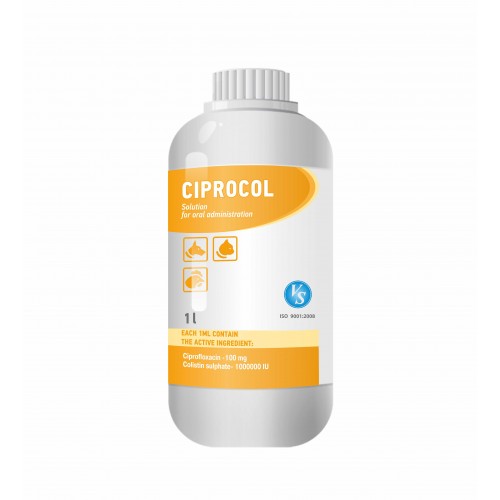
CIPROCOL® (oral solution)
| Ingredients: | Colistin sulfate, Ciprofloxacin |
| Application: | Oral |
| Type of formulation: | Antibiotic |
Description
Light yellow to dark yellow liquid. The formation of a slight sediment may occur.
Composition
1 ml of the product contains the active substances:
- ciprofloxacin — 100 mg
- colistin sulphate — 1,000,000 IU
Excipients: lactic acid, purified water.
Pharmacological Properties
ATCvet classification code: QJ01 — antibacterial veterinary products for systemic use. QJ01RA95 — Polymyxins, combinations with other antimicrobial agents.
CIPROCOL® is a combination product containing two antibiotics. As a result of the synergism of the active substances, the activity of the product is significantly higher than that of its individual components.
Ciprofloxacin is a fluoroquinolone antibiotic active against Gram-negative organisms, namely: Pasteurella multocida, E. coli, Salmonella spp., Shigella spp., Enterobacter spp., Klebsiella spp., Proteus spp., Serratia spp., Campylobacter spp., Pseudomonas aeruginosa, Yersinia spp., Vibrio spp., Aeromonas spp., Haemophilus spp., as well as Brucella spp. Gram-positive microorganisms are also susceptible to ciprofloxacin: Staphylococcus spp. (including penicillinase-producing and methicillin-resistant strains), as well as Mycoplasma spp. and Mycobacterium spp. The mechanism of action of ciprofloxacin consists in the inhibition of bacterial DNA gyrase (topoisomerase II), thereby preventing the process of DNA replication.
Colistin is a polymyxin-group antibiotic synthesised by the aerobic spore-forming rod Bacillus polymyxa. It acts bactericidally against Gram-negative bacteria (such as E. coli, Salmonella spp., Pseudomonas spp.) by binding to the phospholipids of the cytoplasmic membrane, increasing its permeability to both intracellular and extracellular components, which leads to the destruction of cellular barriers and lysis of the bacterial cell.
The oral bioavailability of ciprofloxacin exceeds 70%. The maximum concentration of ciprofloxacin in the blood following oral administration is reached within 1.5–2 hours, and the therapeutic concentration is maintained for 24 hours. Ciprofloxacin penetrates virtually all organs and tissues; however, the highest levels are observed in the lungs, liver, bile, reproductive organs, and kidneys. The product is detected in cerebrospinal fluid at low concentrations, reaching 6–10% of its serum concentration. It is excreted from the body primarily unchanged and as metabolites — which are less active than ciprofloxacin itself — via the urine through tubular secretion and glomerular filtration, as well as via bile.
Colistin is virtually not absorbed from the gastrointestinal tract and is not subject to the effects of digestive enzymes; consequently, a high concentration of colistin is established in the intestine, making it effective in diseases of the gastrointestinal tract. In contrast to the low concentrations of colistin in the serum and tissues, high and constant concentrations are consistently present throughout the various sections of the gastrointestinal tract. It is excreted primarily via the faeces.
Indications
For the treatment of colibacillosis, pasteurellosis, gastrointestinal tract diseases, and mixed or secondary bacterial infections associated with viral diseases in pigeons, caused by microorganisms susceptible to ciprofloxacin and colistin.
Dosage and Administration
Administer orally via drinking water at the following doses:
- 0,5–1,0 ml of the product per 1 litre of drinking water for 3–5 days.
Shake the ampoule or vial before use.
During the treatment period, medicated drinking water should be the only source of drinking water for the birds. Fresh medicated water should be prepared every 24 hours.
Contraindications
Hypersensitivity to ciprofloxacin or colistin.
Do not use in animals with severe renal or hepatic impairment.
Do not use concurrently with tetracyclines, macrolides, ciclosporin, chloramphenicol, or non-steroidal anti-inflammatory drugs (NSAIDs).
Do not use concurrently with products containing the cations Mg²⁺, Al³⁺, or Ca²⁺, as these bind to ciprofloxacin and impair its absorption.
Precautions
Adverse reactions
Not observed at recommended doses. In rare cases, allergic reactions are possible (skin rash, pruritus, and oedema).
Interactions with other medicinal products and other forms of interaction
When used concomitantly with theophylline (aminophylline), ciprofloxacin may increase the plasma level of theophylline.
Concomitant administration with aminoglycosides, third-generation cephalosporins, and broad-spectrum penicillins may produce synergism against certain bacteria (particularly Pseudomonas aeruginosa and other Enterobacteriaceae).
The product is not recommended to be mixed with other medicinal products.
Ciprofloxacin is pharmaceutically incompatible with solutions having a pH > 7.
Presentation
Ampoules of neutral glass grades NS-1, NS-2, USP-1, in volumes of 0.5 ml, 0.75 ml, and 1 ml. Glass vials of 10, 20, 50, and 100 ml. Secondary packaging — cardboard carton.
Polymer bottles of 240 ml.
Storage
Store in a dry, dark place, out of reach of children, at a temperature of 5 °C to 25 °C.
Shelf life
2 years.
Shelf life after first opening the immediate packaging: 7 days.
For veterinary use only!
